Be a Member of this BLOG

Search This Blog

Showing posts with label German. Show all posts

Mar 6, 2014

The Waste Land

Source:http://kirstyahawthorn.wordpress.com/literature/t-s-eliots-the-wasteland-and-the-frankfurt-school/


T.S Eliot’s The Wasteland and The Frankfurt School.


“I’ll show you fear in a handful of dust.” (Eliot, T.S. 1998: 32). T.S. Eliot’s 1922 war poem, The Waste Land is known in literary circles as the most influential poem of the twentieth century. Written in the aftermath of World War 1 and within Eliot’s own recovery from a nervous breakdown The Waste Land in structure, style and content provides a significant critique on the fragmentation of social life. Emerging at a time of deep unrest, the poem reflects not only the physical manifestation of destruction in society but also the social and psychological. The predominant Marxist perceptions based on the structuralist top, down perspective had predicted revolution via the proletariat which had not come to fruition. Instead, the war’s devastation and subsequent rise of fascism brought down utopian belief and created a search for deeper truths. The poem poses no answers to societies problems yet through the use of images and prose it suggests an urgent need for reassessment of traditional Marxist ideology. The poem’s display of desperation shows society at its tipping point within a time of crisis. Intended to be a complex poem, Eliot creates multiple layers and references to classical literature, juxtaposing fragments of various elements of literary and mythic traditions with scenes and sounds from modern life. The effect of this poetic collage is both a reinterpretation of canonical texts and a historical context for his examination of society and humanity. The poem reflects Marxist ideas of ‘alienation’ and ‘species being’ through the use of voice gives the reader a sense of chaotic emotion. Eliot’s representation of societal ideologies (and the breakdown of these) challenges the reader into questioning conventional intellectual discourse. This essay will look at how The Waste Land through the use of different voices provides a social critique on society and social theory. I will draw primarily on The Waste Land and Marxist concepts of alienation and species being with reference to The Frankfurt School (Theodor Adorno, Max Horkheimer and Herbert Marcuse) to support the discussion.

T.S. Eliot was an American born, English citizen who believed strongly in the tradition of the poet and poetry as a way to rewrite the past, ignite a shift in thinking and help to initiate a more positive future. He stated within his own literary critique that “the poet in our civilisation, as it exists as present, must be difficult” (Eliot, T.S. 1945: 50). T.S Eliot was a man who critiqued his own work, acknowledging what he believed to be the responsibility of the poet to society as a whole.  The Waste Land reflects the complexity and frustrations of society with the dramatic effect of being ‘on the outside looking in’, separated from society. In the 1844 Economical and Philosophical Manuscripts Marx states that “man is a species being….and free conscious activity constitutes the species-character of man” (Wartenberg, T. 1982: 77) of which is a central concept to his writings. Eliot’s use of different languages and incoherent, disjointed conversations gives a clear indication of the separateness people are experiencing from their ‘species being’, they are anything but free. Eliot’s intense use of citation and referencing of classical literature; Baudelaire, Dante and Chaucer amongst others creates an underlying intellectual elitism which links the past to the present to the future with ethereal effect.  Eliot clearly saw society to be in a state of crisis and writing thematically he opens the poem with;
April is the cruellest month, breeding
Lilacs out of the dead land, mixing
Memory and desire, stirring
Dull roots with spring rain. (Eliot, T.S. 1998: 31)
By parodying Chaucer’s prologue to The Canterbury Tales and presenting nature like a patient being anaesthetised upon a table (almost like an autopsy), Eliot confuses our ideas of rebirth and resurrection traditionally associated with April with death and cruelty. Clinically dead in tone it creates a sense of depression and from the first line we feel alienated, separated and at a loss of belief in the once strong and hopeful ideals of revolution. The emergence of fascism post-war confirms this pessimism and makes way for Adorno and Horkheimer’s critical theory of which seeks “to liberate human beings from the circumstances that enslave them.”  (Horkheimer, M. 1993: 76).
Through the disjointed structure; incoherent ‘babble’ in different languages (mass immigration into London), references to past texts (as an emotional and intellectual anchor), men and women’s voices and the voices of the dead Eliot draws us into internal enquiry. It is within this constant barrage of voices that the reader questions and tries to make sense of society around them, and indeed their place within it. Eliot poses no answers to the desolation; however he does allude to tradition and poetry as a possible solution. In his 1921 essay, Tradition and the Individual Talent Eliot states that transcendence can come about through the use of words and speaks of poetry in a metaphysical sense with alchemical ability. It is through his poetic style that the socio-psychological wellbeing which Adorno speaks of as incoherent and alienated comes about. His use of voice is both haunting and profoundly relevant to any period in history where there is a collective feeling of confusion, anxiety, distrust and unrest.
For the theorists at The Frankfurt School, an interdisciplinary approach was used to critique and formulate a reassessment of social theory in the wake of two World Wars and fascism. Drawing heavily on Hegel, Marx, and Freud; Theodor Adorno and Max Horkheimer wrote The Dialectic of Enlightenment (1944) which portrayed ambivalence towards the ‘ultimate source’ or foundation of what they described as ‘social domination’, questioning the very ideas of modernity and the enlightenment. The ambivalence presented in The Waste Land points towards the pessimism within which The Frankfurt School saw as overruling the possibility of emancipation and freedom.
In Part 1 of The Waste Land, (The Burial of the Dead) Eliot presents us with the new religion of the occult through the character and voice of a medium with a pack of tarot cards. Based on Madame Blavatsky from the early 20th century we are taken through a reading;
Here is the man with three staves, and here the Wheel,
And here is the one-eyed merchant, and this card,
Which is blank, is something he carries on his back,
Which I am forbidden to see. I do not find
The Hanged Man. Fear death by water.
I see crowds of people, walking round in a ring.
  (Eliot, T.S. 1998: 32)

The loss of belief in religious ideology and its replacement by the occult (through the tarot) questions not only Christian historical grounding but also references the pagan, hooded figures in one of the cards later in the poem to Jesus. The disillusionment in religion runs throughout the poem in one form or another and creates the experience of aloneness without explicitly stating it. The poet is presented as the more insightful medium who brings the past, present and future together through words.
In this brief look at T.S. Eliot’s, The Waste Land we have seen how the rich and complex critique of society in post war London comes alive through Eliot’s use of voices, descriptions and referencing. We have discussed Marxist ideas of alienation and species being in relation to the poem and how social theory progressed with The Frankfurt School’s reassessment and emergence of critical theory. The legacy of The Waste Land has re-emerged at significant points in history and in differing forms as a base for social critique.Desolation Row (1965) by Bob Dylan is one example and more recently in the movie The Hunger Games. Both examples draw on Eliot’s use of voice, which is heightened by the use of digital technology and speaks directly to contemporary society via music. Eliot as a young, revolutionary character created waves in social and literary discourse in the modernist, aftermath period of WW1. Like other pivotal points in history associated with the search for truth there is a period of transition from one regime of truth to the new. The Waste Land is an excellent example of being in the eye of the social storm; a literary work of art created at a crucial point in history and one which reflects the regression from reason which questions modernity in its entirety.
Work Cited.
Eliot, T.S. “Tradition and the Individual Talent.” Sacred Wood: Essays on Poetry and Criticism,47-59. London. Methuen & Co. Ltd. 1945. Print.
Eliot, T.S. The Wasteland, Prufrock and Other Poems. New York: Dover Publications, 1998. Print.
Wartenberg, Thomas E. Human Studies, Vol. 5, No. 2 (Apr. – Jun., 1982), pp. 77-95 ‘”Species-Being” and “Human Nature” in Marx.’ Published by: Springer. Web. Nov 26th 2012.
Horkheimer, M. Between philosophy and social science: selected early writings / Max Horkheimer; trans. G.USA. Cambridge Press. 1993.  Print.


Feb 19, 2014

The Work of Art In The Age of Mechanical Reproduction: Summary

Source: http://frankfurtschool.wordpress.com/2008/02/28/summary-the-work-of-art-in-the-age-of-mechanical-reproduction/
The Work of Art In The Age of Mechanical Reproduction
Walter Benjamin
In his essay, “The Work of Art In The Age of Mechanical Reproduction”, Walter Benjamin discusses a shift in perception and its affects in the wake of the advent of film and photography in the twentieth century. He writes of the sense changes within humanity’s entire mode of existence; the way we look and see the visual work of art has is different now and its consequences remain to be determined. How does human sense perception related to history? Is it a universal perspective that is being critiqued here? Can there be a universal perspective in the first place?
Benjamin here attempts to mark something specific about the modern age; of the effects of modernity on the work of art in particular. Film and photography point to this movement. Benjamin writes of the loss of the aura through the mechanical reproduction of art itself. The aura for Benjamin represents the originality and authenticity of a work of art that has not been reproduced. A painting as an aura while a photograph does not; the photograph is an image of an image while the painting remains utterly original.
The sense of the aura is lost on film and the reproducible image itself demonstrates a historical shift that we have to take account of even if when we don’t necessarily notice it. What does it mean when the aura is lost? How does it function and how does it come about? Benjamin writes of the loss of the aura as a loss of a singular authority within the work of art itself. But what comes through in this new space left by the death to the aura? How does the mechanically reproduced work of art manage to make up for this void?
As Benjamin continues, a tension between new modes of perception and the aura arise. The removal of authority within the original work of art infers a loss of authority, however, in regards to mass consumption, this liberation is not necessarily contingent. The cameraman, for example, intervenes with what we see in a way which a painting can never do. It directs the eye towards a specific place and a specific story; at the same time it is radical and revolutionary it is also totalitarian. It guides us to a particular side of a story and leaves other parts out. It dulls our perception towards the work of art and introduces distraction as a mode of reception. The location of anything we might call the aura has to be moved into a mythological space; into the cult of genius. This cult of genius relates back to the cultish characteristic of the aura itself; in its absence there is a grabbling for a replacement. What does it mean to place an aura on “someone” or “something”? Is it even necessary to reclaim the aura in the first place? The mystical cult of the original in broken with the loss of the aura, and now every one can go to a gallery, a museum, the theater or the cinema. A whole new appreciation of art is introduced while at the same time, a whole new mode of deception and distraction also enters.

For Benjamin, the aura is dead and it exists in an improbable and mystical space. But in the making of our own myths therein lies an aesthetic interpretation of these reproducible images; there is a temporal world that is there for you, where you do not truly participate. The object consumes man at the same time man consumes it. Mass consumption revels in this consequence of the loss of the aura. For Benjamin, a distance from the aura is a good thing. The loss of the aura has the potential to open up the politicization of art, whether or not that opening is detrimental or beneficial is yet to be determined. However, it allows for us to raise political questions in regards to the reproducible image which can be used in one way or another.


Yet Benjamin makes it clear that in this new age of mechanical reproduction the contemplation of a screen and the nature of the film itself has changed in such a way that the individual no longer contemplates the film per say; the film contemplates them. A constantly moving image in the disjunction of the physical arrest of watching a moving image move, changes the structure of perception itself. Within the reproducibility of images there is an increase of submission towards the film itself. In and of itself this marks a symptom and not a cause of something terrible that is happening. How can we think of subjectivity in the age of mechanical reproduction? What does it mean to reflect back onto ourselves after being absorbed by these inauthentic and politicized images? What does the aestheticization of the work of art mean now when the aura is lost?
Key passages:
“During long periods of history, the mode of human sense perception changes with humanity’s entire mode of existence. The manner in which human sense perception is organized, the medium in which it is accomplished, is determined not only by nature but by historical circumstances as well” (Benjamin, 222).
“The surgeon represents the polar opposite of the magician. The magician heals a stick person by the laying on of hands; the surgeon cuts into the patient’s body. The magician maintains the natural distance between the patient and himself; though he reduces it very slightly by the laying on of hands, he greatly increases it by virtue of his authority. The surgeon does exactly the reverse; he greatly diminishes the distance between himself and the patient by penetrating into the patient’s body, and increases it but little by the caution with which his hand moves among the organs. In short, in contrast to the magician—who is still hidden in the medical practitioner—the surgeon at the decisive moment abstains from facing the patient man to man; rather , it is through the operation that he penetrates into him” (Benjamin, 233).
“The act of reaching for a lighter or a spoon is familiar routine, yet we hardly know what really goes on between hand and metal, not to mention how this fluctuates with our moods. Here the camera intervenes with the resources of its lowerings and liftings, its interruptions and isolations, its extensions and accelerations, its enlargements and reductions. The camera introduces us to unconscious optics as does psychoanalysis to unconscious impulses”(Benjamin, 237).
“Let us compare the screen on which a film unfolds with the canvas of a painting. The painting invites the spectator to contemplation; before it the spectator can abandon himself to his associations. Before the movie frame he cannot do so. No sooner has his eye grasped a scene than it is already changed. It cannot be arrested….The spectator’s process of association in the view of these images is indeed interrupted by their constant, sudden change. This constitutes the shock effect of the film, which, like all shocks, should be cushioned by heightened presence of mind. By means of its technical structure, the film has taken the physical shock effect out of the wrappers in which Dadaism had, as it were, kept it inside the moral shock effect” (Benjamin, 238).
“The distracted person too, can form habits. More, the ability to master certain tasks in a state of distraction proves that their solution has become a matter of habit. Distraction is provided by art presents a covert control of the extent to which new tasks have become soluble by apperception. Since, moreover, individuals are tempted to avoid such tasks, art will tackle the most difficult and most important ones where it is able to mobilize the masses. Today it does so in film. Reception in a state of distraction, which is increasing noticeably in all fields of art and is symptomatic of profound changes in apperception, finds in the film its true means of exercise”(Benjamin, 240).
“Mankind, which in Homer’s time was an object of contemplation for the Olympian gods, is now one for itself. Its self-alienation has reached such a degree that it can experience its own destruction as aesthetic pleasure of the first order. This is the situation of politics which Fascism is rendering aesthetic. Communism responds by politicizing art”(Benjamin, 242).

Dec 10, 2013

Anti-Semitism as an Issue in the Trial of Kafka's Joseph K.

Anti-Semitism as an Issue in the Trial of Kafka's Joseph K.
By: Joseph J. Waldmeir
Published: Board of Regents of the University of Oklahoma, 1961

The critical interpreters of Franz Kafka's allegorical examinations of a chaotic modern world have identified and proposed three distinct, occasionally even antagonistic, interpretations: the metaphysical-religious-mystical, the Freudian, and the generally social-cultural. A few of them, including Max Brod and W. H. Auden, have taken a turn toward a somewhat different interpretation on the evidence that Kafka was a Jew, and that his notebooks and letters betrayed great concern with the anachronistic problem of the Jew in modern society. But none of his critics has followed through with an overall investigation and exegesis of Kafka's fiction in terms of this concern.

The present paper is the result of a close exegetical examination of The Trial (London. Penguin Books. 1953) from this point of view. Such an interpretation can contribute valuably to a clarification of Kafka's world view, for if Joseph K. is a Jew then the Kafka hero is not so much a sensitive individual out of tune with his God, with his psyche, or with society in general as he is a member of a group actively opposed by a specific external agency, anti-Semitism. He is trying unsuccessfully to find his place in an antagonistic society while maintaining his dignity and worth as a human being. More than this, futile though they may be, his actions are not wholly self-conscious and negative, but are assertive and positive as well.

The tone of the novel and the nature of the problem are apparent in the first episode of the first chapter. Society, in the person of the two Warders and the Inspector, confronts K. with the accusation that he is a Jew, and waits for K. to acknowledge the accusation. There is no talk of punishment, no talk of incarceration. Society merely informs him of a fact. But the fact implies an anti-Semitic judgment, and it is this which K. fights here and throughout the novel. He refuses to acknowledge the accusation, refuses to confirm or deny his Jewishness, refuses even to laugh the whole business off, as he is aware he could easily do. Stubbornly, he challenges the legal right of his accusers to arrest him for a social crime. Here, for the first time, K. re-sorts to the argumentative device he is to use throughout the book. He attempts to force society back to its major premise. But since society reaches its conclusions more often emotionally than rationally, and rea-sons, if at all, not syllogistically but enthememically, K. succeeds only in erecting an impossible barrier to communication.

 Society cannot understand why, if he is not a Jew, K. does not say it, prove it, and be done with it; or if he is a Jew, why he does not simply admit it and go on about his business. From society's point of view, it is K. who acts irrationally. The whole af-fair is extremely simple; there is nothing to argue about or even to discuss. When K. produces identification, the Warders reject it as being of no consequence in the matter at hand. When K. protests his innocence by asserting that the Law governing his crime exists only in the Warders' minds, one Warder answers: "He admits that he doesn't know the Law and yet he claims he's innocent." When he challenges the authority of the arresting officers, he is advised by the Inspector to "think less about us and of what is going to happen to you, think more about yourself instead." When he offers to consider that the accusation has not been made, the Inspector declines, then departs, leaving K. in the frustrating position of being unable to deny his guilt, and really forced to admit it in order to argue from the untenable position that his guilt should not be considered guilt.

 And the frustration takes the form of a bitter choice between blind acquiescence to society's wishes or hopeless struggle against them in the Fraulein Biirstner episode of the chapter. Fraulein Biirstner's role in the novel is extremely important though she is actively present only in the first chapter. She represents K.'s desire to be a part of society in spite of its unworthiness. Imperfect, tainted, cowardly though she may be, she is a goal for K. In her own frightened interview with him as well as in K.'s interview with her Friend, it is apparent that he shall never attain her as long as he struggles against society's Judgment. But the judgment is stupid. It is impossible for K. to yield, to admit his guilt; but it is equally im-possible for him to reject his desires. In fact, simply because Fraulein Biirstner is denied him, his desire for her is almost desperate.

Motivated by this desire, K. attends the First Interrogation. The Chamber is located in the back room of an old house; the meeting is informal, is somehow clandestine. Angered by the feeling that he is expected to debase himself in such dismal surroundings, K. insists that he be accepted by society on his own terms. He protests so volubly against the accusation itself - avoiding any admission or denial of it - that he convinces his hearers of his guilt.

But guilt or innocence is not the issue and, dissatisfied with his inability to con-vince the interrogators that not the question of his Jewishness but why Jewishness is bad should be debated, K. returns to the chambers a week later. It is empty, but K. finds evidence that convinces him both that all argument is useless and that yielding is, for him, out of the question. He examines the Law books left behind by the Examining Magistrate and finds them filled with obscene, pornographic stories and pictures. While he is present, the Magistrate, a vicious lecher, sends a Law student to kidnap the Court Attendant's wife (she has been the student's unwilling mistress) for his own use. Following them K. learns that the Offices of the Law are located in the attic of the same old house that contains the Interrogation Chamber. K. enters, and is almost suffocated by the stale, strangling air. When a skylight is opened to alleviate the situation, clouds of soot fall through it. K., growing ill, is assisted out of the Offices by two attendants who grow equally ill as they catch a breath of fresh air at the exit.

Neither argument with nor acquiescence to such a Court is possible for a self-respecting man. The Court, if not the Law itself, is capricious, obscene, foul, disgusting, and rapacious. It has no legal sanction: witness its relegation to the attic of an old house (later K. learns that its branches are present in most of the old houses of the city) . It can certainly have no moral sanction. More firmly convinced than ever that he is right and the anti-Semite is wrong, K. must decide on some sort of action. "While he stayed quietly at home," he thinks, "and went about his ordinary vocations he remained superior to all these people and could clear any of them out of his path with a hearty kick." But it is as impossible for K. to remain quietly at home as it is impossible for him to dignify his opponents by disregarding them.

As K. realizes the growing insecurity of his position the necessity to strike back becomes stronger. After his visit to the Court Offices he finds that he is to be cut off permanently from Fraulein Burstner, and his frustrated desire takes the form of the Whipper revenge daydream. K. is extremely ashamed of the dream but he cannot rid himself of it. All that the Warders had done was to accuse him of the truth, for K. is a Jew. The Warders are not responsible for any of the implications in the accusation; to punish them is senseless. Yet, faced with a Law and a Court and Officials such as those he has already dealt with, what alternative had he? Ashamed of the vengeance day-dream or not, like his desire for Fraulein Biirstner, this is something that K. cannot resist or abolish.

 At this, his most discouraging moment so far, his Uncle enters the scene, and K.'s hope and confidence are partially restored. The Uncle has two suggestions: K. can leave the environment as the Uncle had done twenty years before, thus avoiding the problem, or he can avail himself of certain legal weapons at his disposal to fight the case. K. refuses to retreat to the ghetto, and hopefully chooses what appears to be energetic action. It turns out to be action in a vacuum; K.'s hope is false, his confidence misplaced.

Almost immediately K. suspects that the sickly and weak Advocate to whom his Uncle introduces him will prove ineffectual. When he discovers that the Clerk of the Court has been lurking in the shadows of the Advocate's room, signifying that the Advocate is in intimate contact with the Court in charge of K.'s case and is therefore anti-Semitic, K.'s suspicions become certainties and he abruptly leaves the room. Leni, the Advocate's nurse-housekeeper-mistress, attempts to seduce K. into yielding to the wishes of the Court. "You can't put up a resistance to this Court," she says; "you must admit your fault. Make your confession at the first chance you get. Until you do that, there's no possibility of get-ting out of their clutches, none at all." These sentiments are echoed later by the Advocate who explains to K. that "The only sensible thing was to adapt oneself to the existing conditions. ... Anything but draw attention to oneself from above! One must be low, no matter how much it went against the grain." To try to alter things was to in-vite destruction, since the organization would not really change, "unless, indeed, which was very probable, it became still more rigid, more vigilant, more severe. . ." K.'s affair with Leni signifies his desire to yield; in fact, Leni interprets the affair in those terms. But in his more sober mo-ments K. reaffirms his stubborn non-capitu-lation. "Above all," he thinks, "if he were to achieve anything, it was essential that he should eliminate from his mind the idea of possible guilt. There was no such guilt."

Still, his stubbornness has seriously far-reaching ramifications. His position at the bank has been placed in jeopardy, leading the Manufacturer, one of his erstwhile clients, to suggest that he attempt to get the artist Titorelli to intercede for him. The presence of his Uncle has reminded K. that his family is somehow involved in the case, too, that though he fights alone he may not win or lose alone. This latter responsibility is far more terrible than his responsibility to himself, and K. is not permitted to for-get it. He is motivated to go to Titorelli by the weakening of his authority at the bank, out the torments he suffers at the hands of the little crippled girls attached to Titorelli's boarding house are haunting reminders that his actions may be responsible for the fate of the whole family of Jews.

Titorelli is the artist who in a sense has created the Examining Magistrates of the Court by falsifying their stature, their dignified mien, and their judicial surroundings in his portraits of them. While K. waits, Titorelli elaborates on a portrait of Justice until she is changed into a likeness of the Goddess of the Hunt in full cry. In spite of this warning by the master dissembler, and in spite of the warning implicit in the Furies' pursuit of him up the stairs to Titorelli's studio, K.'s hopes rise when the artist accepts his assertions of innocence.

Titorelli points out and defines three pos-sible solutions to the case of an innocent man: Definite Acquittal, which is theoretically possible but actually impossible, though legends indicate that such acquittals may have taken place in the ancient past (a probable reference to the vindication of the Jews as Chosen People in the Old Testament) ; Ostensible Acquittal in which the charge is lifted for a short time or until a new arrest is made (a reference to the possibility that the Jew may win over part of society but never all of it) ; and Indefinite Postponement in which the accused may go on with his life in a probable conviction that his case will never come to a conclusion (a reference to the apparent acceptance of the Jew into society as a Jew) .

Throughout Titorelli's exposition the Furies clamor outside the door and the studio becomes stiflingly, disgustingly hot and air-less. In spite of a tremendous lethargy which settles on K., in spite of an over-whelming desire to yield, K. has the cour-\age and wit to see through the two possible proposals." 'Both methods have this in common/ " says Titorelli, " 'that they save the accused from coming up for sentence.' 'But they also prevent an actual acquittal,' said K. in a low voice, as if embarrassed by his own perspicacity. 'You have grasped the kernel of the matter,' said the painter quickly."

With Titorelli's admission, K. manages to rouse himself sufficiently to leave the studio. But first he buys three of Titorelli's paintings, all exactly the same, as all three suggested solutions have been exactly the same. To escape the Furies, K. leaves by a different door, and finds himself in another branch of the Law Court Offices to which Titorelli's studio is actually an adjunct. The musty, sickening air becomes more nauseating, and K. dashes through and out of the Offices closely pursued by the Furies who have managed somehow to reach him.

Bewildered, misled by his Uncle, by the Advocate, by the painter, K. resolves to con-tinue his struggle without help. He meets Block, the Commercial Traveler, in the Advocate's home and learns that at least part of his trouble is founded on superstition. Block tells him of the general belief that one's guilt is betrayed by a certain facial characteristic, not the size and shape of his nose, but the set of his lips. K. also learns from Block that his case is being tried before a Low Court, and that the function of the Low Court appears to be to work unceasing-ly to prevent the accused, like Block and K., from carrying his case to the High Court; that society actively prevents final judgment, the examination of the major premise, in the case of the recalcitrant Jew. And finally, witnessing Block's debasement by the advocate, K. learns that "the Advocate's methods, to which K. fortunately had not long enough been exposed, amounted to this : that the client finally forgot the whole world and lived only in the hope of toiling along this false path until the end of his case should come in sight." His new knowledge only serves to entrench K.'s stubbornness, to make more adamant his refusal to yield. He unequivocally dismisses the Advocate.

Betrayed, trapped, once again alone in his trial, K. is assigned the responsibility of guide for an Italian official whom he can-not understand well enough to converse with. The Italian, clearly a representative of historical Christianity, suggests that they meet at the Cathedral to begin their tour. K. arrives first, and while waiting, decides to evaluate the paintings in the Cathedral. The first and only one which he examines, and that dimly, in the flickering light of his pocket torch, is of Christ being laid in the sepulchre while an armored knight stands guard.

The painting is a revelation. Implicit in it is the major premise for which K. has sought so eagerly throughout the trial: the Law is the curse of the Christian God upon the Christ-killer Jew. Society effectively enforces the curse simply by guarding the tomb, that is, by being Christian. There is no need for K., the Jew, to examine the other paintings in the Cathedral; there is no need to wait longer for the Italian official. But K. hesitates. The argument of the painting seems to him not absolute and irrevocable. He is disturbed by society's role as unreasoning enforcer of the curse, and by serious doubts as to the validity of the premise. Thus he is summoned to the pulpit to have his questions answered.

His case is progressing badly, the priest tells him." 'You are held to be guilty. Your case will perhaps never get beyond a lower court. Your guilt is supposed, for the pres-ent at least, to have been proved.' 'But I am not guilty/ K. answers. 'It's a misunderstanding. And if it comes to that, how can any man be called guilty? We are all simply men here, one as much as the other.* 'That is true/ said the priest, 'but that is how all guilty men talk.'

"No argument is possible, as none had been possible at the beginning of the trial. The Court's decision is a foregone conclusion either with or without the premise; but granting the premise, the case is even more hopeless and struggle is useless. Neither K.'s legal nor extra-legal, formal nor informal machinations can serve to resolve the chaos resulting from his stubbornness and society's prejudice. The Jew must simply accept his place on the perimeter of society, even though accepting it gains him nothing but the absence of struggle. The priest points out that K. has hurt his cause specifically by seeking outside help, particularly the help of women. K.'s reply, that the natures of the Court and of the lecherous examining magistrate are such that the inter-cession of women might conceivably aid his cause, betrays a misunderstanding of society's function and motivation, betrays a con-fusion of the Law with the Court.

 "Can't you see anything at all?" the priest shrieks.

He then attempts to explain to K. the complex relationship among the Law, society, and the Jew by reciting to him the parable of the doorkeeper. The doorkeeper is society, or the Low Court, authorized by the High Court to stand between the Jew and the Law. He does not know why he stands there. He has not, nor ever can have, any direct knowledge of the Law. But he does have the Law's authorization, and this is a sufficient justification for his actions, irrational though they may appear to be. The Law exists above and beyond and regardless of society; the doorkeeper is distinct from the Law even though he serves it. This is the most deadly point of all. In the parable the Jew cannot achieve even a minimum converse with the doorkeeper, let alone the Law, either by pleading, arguing, or gift-giving. But even if the door-keeper were to change in his attitude, even if K. were to be accepted unqualifiedly into society, there would follow no ultimate change in the Law. The Jew, as the priest puts it, is not really barred by the doorkeeper; he is merely not admitted.

 The Law is vulnerable; it has to be. A major premise so intimately connected with irrationality cannot stand firm against the attack of reason. K. strikes at its weakest point: he asserts that the doorkeeper is either simple-minded or a swindler. The priest answers that to doubt the doorkeeper is to doubt the Law, since the doorkeeper serves the Law. K., not yet ready to denounce the Law, denies only that it is a proper justification: "'I don't agree with that point of view,' "he says;" 'for if one accepts it, one must accept as true every-thing the doorkeeper says.' 'No, said the priest, 'it is not necessary to accept every-thing as true, one must only accept it as necessary. "

Cornered now, K. realizes that he cannot defeat the Law, vulnerable though it may be, since it exists so potently simply by virtue of its vulnerability. The Court, society, is separate from the Law, can never under-stand the premise justifying its acts, could accomplish nothing even by understanding it or by acting differently- yet to disavow society is to disavow the Law and to invite destruction. K. does not hesitate. With desperate courage he answers the priest. "A melancholy conclusion," he says. "It turns lying into a universal principle."

Society must destroy any man, but especially the Jew, who forces it back to the basic premises upon which it rests its prejudices and actions, and who then flatly dismisses the premises as lies. K's brave denunciation of the Law has sealed his fate.

 But K.'s courage gives way briefly to depression. As he is being led to his execution in the final chapter he catches a fleeting glimpse of Fraulein Biirstner, hurrying away from him, still unattainable, and he "suddenly realized the futility of resistance." But just as suddenly the depression is re-placed by a reborn courage; This is the first time he has seen Fraulein Biirstner since early in the trial, and though she is moving away from him she is no longer cut off from him by her Friend or Captain Lance. He has refused to yield, to admit his guilt even in the vain hope that he could thereby achieve his goal. The goal has been removed farther and farther from him because of his stubbornness, but now suddenly it is there before him, not clearly perceptible, hurrying away, still unattainable- but there nonetheless, as if his very stubbornness itself had forced it to appear.

 His courage and defiance renewed, K. asks himself: "Am I to leave this world as a man who shies away from all conclusions? Are people to say of me after I am gone that at the beginning of my case I wanted it to finish, and at the end of it I wanted it to begin again? I don't want that to be said." He must be destroyed, but if he meets his fate bravely, defiantly, protesting-ly, placing the onus of it on society, then his death shall not have been in vain, for his dignity and manhood will be restored. He refuses to place the knife in his own throat, and as society drives it home, he dies "Like a dog!" pointing a prophetic finger at society, crying out the words "as if he meant the shame of [them] to outlive him."

The interpretation of The Trial offered in this paper is, in spite of its singularity, perfectly consistent with the three standard interpretations as they are in fact perfectly consistent with one another. The various episodes and incidents cited in support of the argument here have been justly used to support the other arguments as well. Thus for example the Cathedral episode is climactic on all levels. It contains not only the symbolic justification for society's tyrannical anti-Semitism, but it also justifies symbolically the tyranny of conformity under which not only the Jew, but modern man in general lives. And it is at the same time the House of Kierkegaard's tyrant God, and of Freud's tyrant Father.

 Too many Kafka critics, in their enthusiasm for their own interpretations, have occasionally forgotten that his work is allegory, and that it is in the nature of allegory to be ambiguous. The allegorist examines metaphorically the causes and consequences of a human condition, in Kafka's case, the chaotic condition of the modern world. The metaphors become levels of meaning, and the allegory owes its artistry to the consciously intricate mingling and meshing of the levels. The allegory is ultimately clear only in terms of the metaphors; the critic must treat its ambiguity with respect. When he submits the work, as I have The Trial, to a close and careful exegetical examination from the point of view of one of its levels, he must constantly be aware that the other levels exist, or he in effect destroys the allegory.

The object of this paper has not been to add to and enrich Kafka criticism, but to clarify his allegorical argument and conclusions by emphasizing the richness in the texture of his work. Reading The Trial, or The Castle, or America, or many of the short stories as considerations and condemnations of society's vicious persecution of the Jew does not weaken their artistry but strengthens it. The chaos is not resolved here. But simply hearing in the work, how-ever faintly, a note of protest, a defiant cry, a hopeless prophecy is to discover a new, more optimistic dimension in Kafka's world view, and a greater depth of meaning in his allegory. Michigan State University 

FRANZ KAFKA (Courtesy Austrian Information Service, N. Y.) (see page 10)

Nov 26, 2012

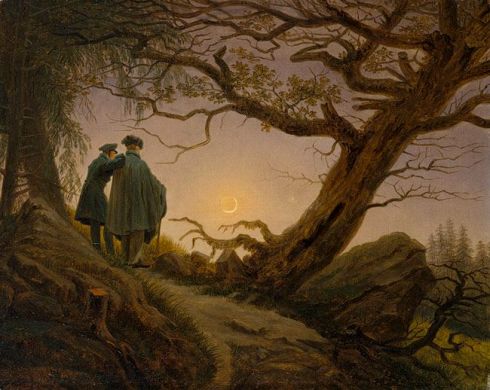
Waiting for Godot and Caspar David Friedrich

How wonderful the little connections that pile up in the day to day. Blanco has long had an interest in the German expressionist painters of the early twentieth century, and was interested to learn, while reading about them the other day that Caspar David Friedrich, the great Romantic painter of lonely figures cast against majestic landscapes, was resurrected by the expressionists after falling into obscurity during the latter part of his life (when he was deemed ‘half-mad’) and after his death in 1840. (Friedrich was also taken up by the Nazis, as embodying the concept of heroic individualism, but he can hardly be blamed for that, and would, in any case – had he lived in the 1930s and 40s –have been incarcerated by them as a madman.)

Samuel Beckett had a great love for the visual arts, and – largely as a consequence of a love affair – during the 1920s and 1930s made several trips to Germany, followed by a longer trip in 1936-7, in which his diaries detail extensive visits to art galleries.

It is interesting therefore, to learn that the author of Waiting for Godot, considered by many to exemplify the most profoundly pessimistic vision of humanity in Western literature, and the absurd insignificance of mankind, should have identified a work by Caspar David Friedrich as the inspiration for his play. According to his biographer, James Knowlson (whose work is based on extensive interviews with Beckett himself) the writer told his friend, theatre critic Ruby Cohn, while looking at the 1824 painting Mann und Frau den Mond betrachend (Man and Woman observing the Moon) in Berlin: “this was the source of Waiting for Godot, you know.

However things are rarely as simple as they appear. Beckett, it seems, might have been confusing two paintings, according to Knowlson, because “at other times he drew attention of friends to Zwei Männer betrachten den Mond (Two men contemplating the Moon) from 1819.” As you can see, the two pictures are not wildly different (and there are various versions of both, it seems).

The point is, the image of the two tramps, Estragon and Valdimir gazing out over an alien landscape, makes a lot of sense in relation to these paintings.

But there is more.

Caspar David Friedrich is regarded as representing the apogee of the Romantic movement in the visual arts, setting down images of the Byronic hero, manfully facing down the forces of nature, the unknown, the abyss. Romanticism is precisely this: it arose at a period when the idea of God was being translated into the idea of nature. Poets set out on hikes into nature (Wordsworth and Coleridge tramping through Wales and the Lake District, Byron in the Alps writing Manfred . . . and with Shelley in Italy). Posh chaps didn’t walk in the countryside until then – no one did except the peasant farmer and the humble shepherd – and suddenly ‘Nature’ was opened up as this vast, wild, unexplored terrain (which in turn informs an understanding of the Romantic Imagination).

According to the art critic Robert Hughes, in an article on Friedrich,

“If there is one word for the mood of Friedrich’s pictures it is “longing”: the desire, never satisfied, to escape from the secular conditions of life into union with a distant nature, to be absorbed in it, to become one with the Great Other, whether that other is a mountain crag, an ancient but enduring tree, the calm of a horizontal sea, or the stillness of a cloud.”

How does this lead back to Beckett? Is Waiting for Godot, in essence, a play about longing? Longing for union with the godhead, with a distant nature, absorption with the Great Other, as conceived by a Romantic painter such as Friedrich?

Blanco can’t say, in fact is rather bowled over by all this and in need of a lie down. Any comments welcome.

Oct 3, 2012

Waiting for Godot: Movie

Watch the Complete movie of the Drama (One Act Play)
Download this mobile version
best view in Mozila Firefox browser


Sep 17, 2010

Paul Heyse

Many famous writers from several countries have been proposed for this year's Nobel Prize in Literature. The Swedish Academy has awarded it to a writer whose nomination has been supported by more than sixty German experts on art, literature, and philosophy.

All Posts

" Indian "Tomb of Sand A Fine Balance A House for Mr. Biswas Absurd Drama Achebe Across the Black Waters Addison Adiga African Ages Albee Alberuni Ambedkar American Amrita Pritam Anand Anatomy of Criticism Anglo Norman Anglo Saxon Aristotle Ariyar Arnold Ars Poetica Auden Augustan Aurobindo Ghosh Backett Bacon Badiou Bardsley Barthes Baudelaire Beckeley Bejnamin Belinda Webb Bellow Beowulf Bhabha Bharatmuni Bhatnagar Bijay Kant Dubey Blake Bloomsbury Book Bookchin Booker Prize bowen Braine British Brooks Browne Browning Buck Burke CA Duffy Camus Canada Chaos Characters Charlotte Bronte Chaucer Chaucer Age China Chomsky Coetzee Coleridge Conard Contact Cornelia Sorabji Critical Essays Critics and Books Cultural Materialism Culture Dalit Lliterature Daruwalla Darwin Dattani Death of the Author Deconstruction Deridda Derrida Desai Desani Dickens Dilip Chitre Doctorow Donne Dostoevsky Dryden Durkheim EB Browning Ecology Edmund Wilson Eliot Elizabethan Ellison Emerson Emile Emily Bronte English Epitaph essats Essays Esslin Ethics Eugene Ionesco Existentialism Ezekiel Faiz Fanon Farrel Faulkner Feminism Feminist Criticism in the Wilderness Ferber Fitzgerald Foregrounding Formalist Approach Forster Foucault Frankfurt School French Freud Frost Frye Fyre Gandhi Geetanjali Shree Gender German Germany Ghosh Gilbert Adair Golding Gordimer Greek Gulliver’s Travels Gunjar Halliday Hard Times Hardy Harindranath Chattopadhyaya Hawthorne Hazara Hemingway Heyse Hindi Literature Historical Materialism History Homer Horace Hulme Hunt Huxley Ibsen In Memoriam India Indian. Gadar Indra Sinha Interview Ireland Irish Jack London Jane Eyre Japan JM Synge Johnson Joyce Joyce on Criticism Judith Wright Jumpa Lahiri Jussawalla Kafka Kalam Kalidasa Kamla Das Karnard Keats Keki N. Daruwala Kipling Langston Hughes Language Language of Paradox Larkin Le Clezio Lenin Lessing Levine Life of PI literary Criticism Luckas Lucretius Lyrical Ballads Macaulay Magazines Mahapatra Mahima Nanda Malory Mamang Dai Mandeville Manto Manusmrti Mao Marlowe Martel Martin Amis Marx Marxism Mary Shelley Maugham McCarry Medi Media Miller Milton Moby Dick Modern Mona Loy Morrison Movies Mulk Raj Anand Mytth of Sisyphus Nabokov Nahal Naidu Naipaul Narayan Natyashastra Neo-Liberalism NET New Criticism new historicism News Nietzsche Nikita Lalwani Nissim Ezekiel Niyati Pathak Niyati Pathank Nobel Prize O Henry Of Studies Okara Ondaatje Orientalism Orwell Pakistan Pamela Paradise Lost Pater Pinter Poems Poetics Poets Pope Post Feminism Post Modern Post Structuralism post-Colonialism Poststructuralism Preface to Shakespeare Present Prize Psycho Analysis Psychology and Form Publish Pulitzer Prize Puritan PWA Radio Ramanujan Ramayana Rape of the Lock Renaissance Restoration Revival Richardson Rime of Ancient Mariner RL Stevenson Rohinton Mistry Romantic Roth Rousseau Rushdie Russia Russian Formalism Sartre Sashi Despandey Satan Sati Savitri Seamus Heaney’ Shakespeare Shaw Shelley Shiv K.Kumar Showalter Sibte Hasan Slavery Slow Man Socialism Spender Spenser Sri Lanka Stage of Development Steinbeck Stories Subaltern Sufis Surrealism Swift Syed Amanuddin Tagore Tamil Literature Ted Hughes Tennyson Tennyson. Victorian Terms Tess of the D’Urbervilles The March The Metamorphsis The Order of Discourse The Outsider The Playboy of the Western World The Politics The Satanic Verses The Scarlet Letter The Transitional Poets The Waste Land The Work of Art In The Age of Mechanical Reproduction The Wuthering Heights Theatre of Absurd Theory Theory of Criticism Theory of Evolution Theory of Literature Thomas McEvilley Thoreau To the Lighthouse Tolstoy Touchstone Method Tughlaq Tulsi Badrinath Twain Two Uses of Language UGC-NET Ukraine Ulysses Untouchable Urdu Victorian Vijay Tendulkar Vikram Seth Vivekananda Voltaire Voyage To Modernity Walter Tevis War Webster Wellek West Indies Wharton Williams WJ Long Woolfe Wordsworth World Wars Writers WW-I WW-II Wycliff Xingjian Yeats Zadie Smith Zaheer Zizek Zoe Haller